Endometrial receptivity and reproductive outcomes in adenomyosis, fibroids and endometriosis: Interim insights from the REAdME study
Mára Michal1; Lukavec, Vojtěch1; Abaffy Pavel2; and Borčinová, Martina1
1 Center for Minimally Invasive Gynecology Surgery, Department of Gynecology, Obstetrics and Neonatology, First Faculty of Medicine, Charles University, General University Hospital, Prague. 2 Institute of Biotechnology of the Czech Academy of Sciences, BIOCEV, Vestec, Czech Republic
Problem statement
Adenomyosis, uterine fibroids and endometriosis may impair fertility through mechanisms extending beyond anatomical changes, including alterations in endometrial receptivity. However, the relationship between endometrial molecular profiles and subsequent pregnancy remains incompletely understood, and the reproductive benefit of surgery is uncertain across several disease phenotypes. REAdME trial (Fertility limiting diseases of pelvic organs and their influence on receptivity of endometrial cavity) integrates prospective reproductive follow-up with endometrial transcriptomics to investigate these relationships and support more individualized treatment decisions.
Methods
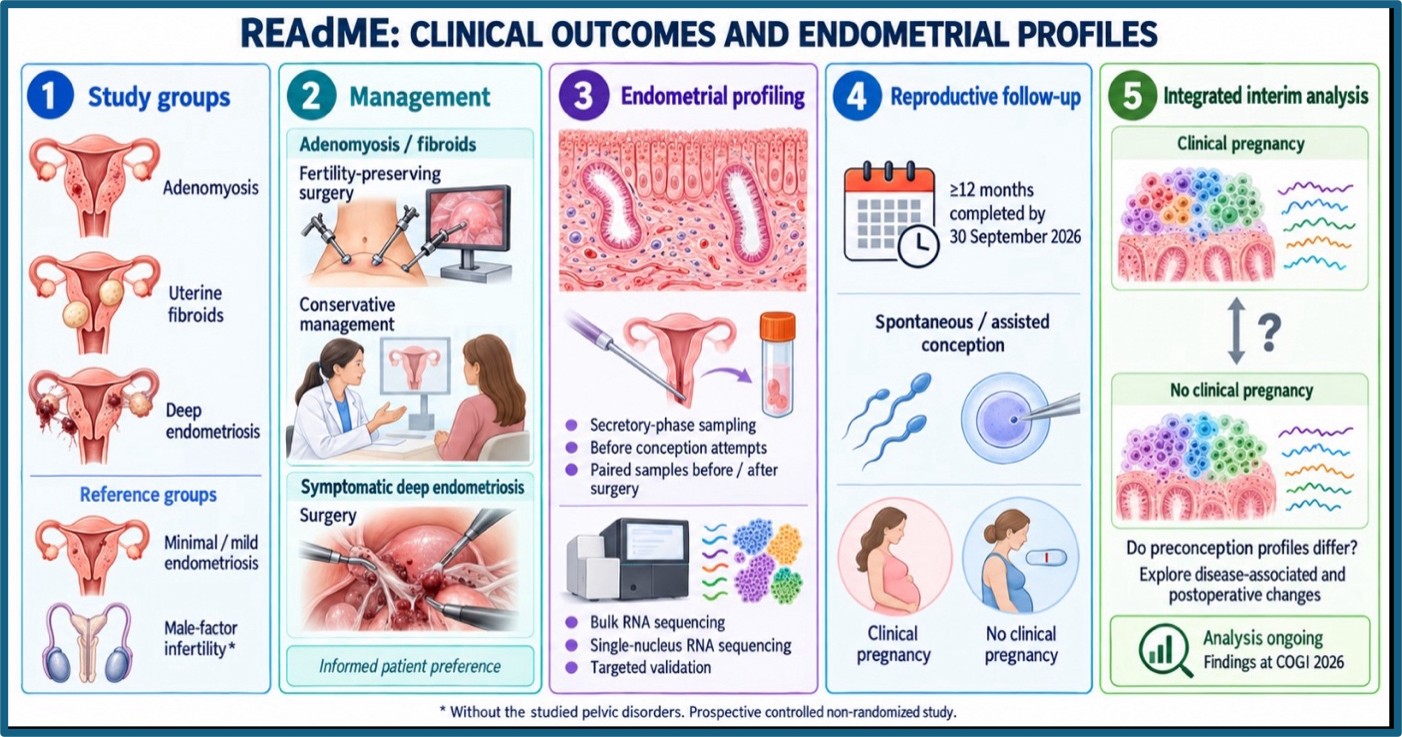
REAdME is a prospective, controlled, non-randomized study enrolling women with adenomyosis, uterine fibroids and deep endometriosis, alongside reference groups comprising women with minimal or mild endometriosis and women with male-factor infertility without these pelvic disorders. Women with adenomyosis or fibroids undergo fertility-preserving surgery or conservative management according to informed patient preference; symptomatic deep endometriosis is treated surgically. Secretory-phase endometrial biopsies are obtained before attempts to conceive, with paired preoperative and postoperative sampling in surgical groups. The molecular workflow combines bulk RNA sequencing, single-nucleus RNA sequencing and targeted validation. The interim analysis includes participants who completed at least 12 months of follow-up by 30 September 2026, linking reproductive outcomes with available endometrial molecular data (Fig. 1).
Results
Interim findings will be presented, integrating clinical pregnancy outcomes with endometrial transcriptomic profiles. Analyses will examine whether preconception molecular profiles differ between women who subsequently achieved clinical pregnancy and those who did not. Reproductive outcomes will be considered across disease groups and management strategies, distinguishing spontaneous conception from assisted reproduction. Disease-associated molecular features and postoperative changes will also be explored where paired samples are available.
Conclusion
By linking reproductive outcomes with endometrial molecular profiles, REAdME aims to clarify the contribution of endometrial biology to infertility associated with adenomyosis, uterine fibroids and endometriosis. The lecture will discuss the interim findings within the broader debate on fertility-preserving surgery, individualized reproductive counselling and the potential role of molecular profiling in future treatment selection.
Disclosure of interest: The authors declare no conflicts of interest.
Funding: Ministry of Health of the Czech Republic, grant NU23-06-00327, and Charles University, UNCE/24/MED/018.
Figure 1. Graphical abstract
Debate: The Choice of Gonadotropins and Cycle Monitoring during Stimulation: It Is Important
Evangelos Makrakis
Obstetrician & Gynaecologist, Specialist in Assisted Reproduction
Associate Professor, Medical School, University of Nicosia
Visiting Professor, Medical School, University of Athens
Scientific Director of ‘HYGEIA IVF – Embryogenesis’ Unit, AthensControlled ovarian stimulation (COS) is a cornerstone of ART, yet the optimal strategy cannot be reduced to a “one-size-fits-all” approach. Although current evidence does not demonstrate the superiority of any particular gonadotropin preparation or of an intensive cycle monitoring, both gonadotropin selection and targeted monitoring remain clinically important and continue to be implemented by physicians worldwide to tailor treatment to individual ovarian physiology, safety profiles, and treatment goals.
Gonadotropin preparations differ in their FSH and LH origin, activity, pharmacokinetic characteristics and dosing strategies. In the general IVF population, recombinant FSH and hMG achieve broadly comparable outcomes, and routine LH supplementation is not supported. However, selected phenotypes may require a different approach. Women with profound LH deficiency require LH activity for adequate follicular steroidogenesis, while evidence suggests that selected women demonstrating an unexpected hypo-response despite adequate ovarian reserve may benefit from reconsideration of the stimulation strategy, including LH supplementation. The later may also apply for women 35-40 years old with a previous unfavourable COS. Furthermore, individualised follitropin-delta meticulous dosing based on algorithm has demonstrated non-inferior reproductive efficacy while reducing excessive ovarian response and OHSS-related interventions. Finally, corifollitropin alpha may be a valuable choice when adherence to treatment, alleviation of distress and reduction of injection burden are important considerations.
Meticulous cycle monitoring transforms the initial strategy into dynamic clinical management. Ultrasound remains the primary monitoring tool, while hormonal assessments should be selective and actionable rather than routinely intensive. Estradiol levels can complement follicle number in assessing an excessive or discordant response and contribute to OHSS risk assessment, whereas unexpected declines may have prognostic value indicating rescue interventions. Trigger-day progesterone levels are particularly relevant when a fresh embryo transfer is planned, as a premature elevation may prompt a freeze-all strategy followed by frozen embryo transfer. Selective LH and progesterone assessment may also be informative when premature luteinisation is suspected, while trigger and post-trigger hormonal assessment can be considered in selected patients at risk of an inadequate response to GnRH-agonist.
Thus, the importance of gonadotropin choice and monitoring does not lie in prescribing our preferred medications or performing more tests. It lies in tailoring treatment, obtaining clinically meaningful information, and translating that information into appropriate clinical action The objective of modern ovarian stimulation should be neither maximal ovarian response nor maximal monitoring, but an individualised strategy that optimises oocyte yield and cumulative reproductive potential while minimising treatment burden and risk.
The cost-effectiveness of re-biopsy and post-cryopreservation biopsy in PGT-A cycles
Alessandro Bartolacci, Italy
Repeated embryo manipulation during preimplantation genetic testing for aneuploidy (PGT-A), including re-biopsy and biopsy after cryopreservation, has become an increasingly relevant clinical and laboratory issue. This presentation reviews the available evidence on the impact of double vitrification and repeated trophectoderm biopsy on embryo viability and reproductive outcomes, and explores the clinical and economic implications of these strategies. Current evidence suggests that repeated micromanipulation may compromise embryo competence, although the magnitude of the effect remains heterogeneous across studies. A review of 12 studies evaluating double biopsy and/or double vitrification identified five studies reporting no significant association with clinical outcomes and seven suggesting a negative effect. The most recent meta-analytic evidence indicates that double vitrification with single biopsy may be associated with an approximately 8.3% reduction in live birth rate, whereas double biopsy combined with double vitrification may be associated with reductions of approximately 15.3% in clinical pregnancy rate and 39.3% in live birth rate, together with an approximately 105% increase in miscarriage rate. Data comparing re-biopsy with transfer of no-result blastocysts suggest that both approaches require careful consideration, particularly because the effectiveness and clinical utility of PGT-A itself remain debated. A multicentre cost-effectiveness analysis further evaluated re-biopsy and post-cryopreservation biopsy according to maternal age, blastocyst availability and healthcare-system costs. Although additional PGT-A-related manipulation may reduce the number of ineffective transfers in selected patients, it was consistently associated with lower modeled live birth probability and was not universally more cost-effective than untested blastocyst transfer. The economic balance varied substantially between centers and with maternal age and blastocyst cohort size. Overall, repeated biopsy and double vitrification should not be considered routine interventions in PGT-A cycles. Decisions should instead be individualized according to maternal age, number and quality of available blastocysts, indication for genetic testing, local regulatory and economic conditions. Comprehensive counseling should explicitly address the potential biological cost of additional embryo manipulation and the uncertainty surrounding long-term neonatal outcomes. Further large, high-quality studies and long-term follow-up are needed to better define the clinical safety and reproductive consequences of repeated embryo manipulation.
Personalization of ovarian stimulation, do we need to base it on age and markers of ORT
Frank Broekmans
Professor Emeritus Reproductive Medicine, University Medical Center, Utrecht,
Consultant Gynecologist RM at the Centre for Infertility Care, Dijklander Hospital, Purmerend,
The Netherlands
The aim of ovarian stimulation is to obtain more than 1 oocyte, as one oocyte is the yield of endogenous FSH stimulation in the normal menstrual cycle, and this level needs to be clearly surpassed to make assisted reproduction efficient. At the same time we will start to ask the question how many oocytes we then need to have an optimal chance of a live birth for the couple? We immediately look at data that correlate oocyte number with the chance of live birth and state that 10-15 oocytes is the optimal number as it will also help managing the prevention of the Ovarian Hyperstimulation Syndrome. From dosage comparison and dosage response studies it has become clear that for an individual woman the number of oocytes does not affect the chance of getting to a live birth. The age of the woman has shown to be the key factor of success, and the number of follicles or oocytes is only relevant for safety management.
Our abilities to forecast the ovarian response to FSH stimulation is quite well managed with tools like the Antral Follicle Count and the AMH level. Today the antagonist LH peak suppression protocol is highly preferred in both predicted Low and High responders. Low responders do not need higher than normalsFSH dosages, while predicted high responder may benefit from a slightly lower starting dosage, and, if a high or excessive response is still obtained, an agonist trigger combined with freeze all will serve safety.
With increasing female age final succes srates become more and more disappointing, due to the fall in oocyte quality. The use of high FSH dosages, specific FSH compounds containing also LH or LH like components, nor the combination of urinary with recombinant products will have any beneficial effect on the prospects of success. The only factor that can be positively affected is the factor time that it takes to fully use a couples potential and create rapid execution of treatment cycles.
Debate:Any place for AI in ovulation induction? YES
Konstantinos Dafopoulos
Professor of Obstetrics and Gynecology
Department of Obstetrics and Gynecology, School of Health Sciences, Faculty of Medicine,
University of Thessaly, Larissa, Greece
Artificial intelligence (AI) is rapidly evolving from prediction toward clinical decision support in controlled ovarian stimulation (COS), where clinicians must integrate age, ovarian reserve, endocrine profile, follicular dynamics, and treatment variables while balancing oocyte yield, safety, burden, and cost. AI is particularly suited to this multidimensional, dynamic process because it can identify nonlinear interactions and continuously update individualized predictions.
Retrospective evidence is already substantial. Machine-learning models using random forests, gradient boosting, XGBoost, neural networks, and multimodal approaches have predicted gonadotropin requirements and optimal trigger timing, low and hyper-response, oocyte and metaphase-II (MII) yield, OHSS risk, frequently outperforming conventional regression or isolated ovarian-reserve markers. Recent studies involving thousands to tens of thousands of cycles report clinically relevant discrimination, while external validation in selected models supports potential generalizability. Explainable-AI methods such as SHAP additionally provide insight into patient-specific drivers of predictions.
Prospective evidence is now emerging. Stim Assist, evaluated prospectively against matched historical controls that were treated by the same doctors and did not use AI, showed numerical increases in oocytes and MII oocytes together with lower FSH consumption, although differences were not statistically significant. Importantly, three prospective randomized trials have evaluated Opt-IVF, a model-based optimal-control decision-support system rather than conventional machine learning. All these prospective randomized trials showed that Opt-IVF consistently reduced cumulative gonadotropin exposure while improving oocyte/MII yield, good-quality blastocysts, and clinical pregnancy. The largest multicentre randomized trial reported approximately 20% lower total dosage of FSH and improved reproductive outcomes with Opt-IVF. These findings provide proof of concept that algorithm-guided, individualized COS can outperform conventional physician management.
Most importantly, the evidence is still evolving. Randomized trials specifically testing machine-learning AI are needed. The IDoser multicentre trial was designed to compare ML-selected versus clinician-selected starting FSH dose, while the ongoing AI-TOP randomized trial is evaluating AI-assisted trigger timing, with MII oocytes as its primary endpoint. Such prospective trials are expected to clarify whether predictive superiority translates into better reproductive outcomes, including medication exposure, monitoring burden, cumulative live birth, OHSS, and cost-effectiveness.
Therefore, the answer to “Any place for AI in ovulation induction?” is unequivocally “yes”. AI should not replace the reproductive specialist, but it should amplify clinical expertise. AI has the potential to become a central component of precision COS—making treatment more personalized, safer, more efficient, and, ultimately, more successful for patients undergoing IVF.
Deep learning versus manual morphology-based embryo selection in IVF: Results of the largest published RCT
Christos Venetis1,2
11st Department of Obstetrics and Gynaecology, Aristotle University of Thessaloniki, Greece
2UNSW Sydney, Australia
Embryo selection by morphology is subjective, and embryologists often disagree on which blastocyst to transfer. Deep learning algorithms such as iDAScore rank embryos automatically from time-lapse videos, but on transferred blastocysts their retrospective discrimination is modest (AUC 0.67).
VISA, a double-blind noninferiority randomised controlled trial in 14 clinics in four countries, randomised 1,066 women aged <42 years with at least two blastocysts to single blastocyst transfer selected by iDAScore or by standardised morphology. Clinical pregnancy rates were 46.5% versus 48.2% (risk difference −1.7%, 95% CI −7.7 to 4.3). Because the lower limit crossed the −5% margin, noninferiority was not demonstrated: an inconclusive result, not evidence of inferiority. Live birth rates were 39.8% versus 43.5%, with no safety signal. The algorithm chose the embryologist’s embryo in two of three cases and cut assessment time about ten-fold. Embryologists outperformed the planning assumption (48.2% vs 35.4%), leaving the trial underpowered; an exploratory signal favouring morphology in freeze-all cycles requires confirmation.
RCTs of other selection algorithms (KIDScore D5, SelecTIMO) likewise showed no gain. Today, deep learning offers standardisation and efficiency, not higher pregnancy rates. Because algorithms evolve faster than trials, adaptive and registry-based designs are needed. The future lies with the embryologist working with the machine.
Debate: Claims of lower miscarriage rate and speed up of the time to pregnancy with PGT-A (PRO)
This justifies the cost and utilization of PGT-A!
Christos Venetis1,2
11st Department of Obstetrics and Gynaecology, Aristotle University of Thessaloniki, Greece
2UNSW Sydney, Australia
Randomised controlled trials (RCTs) show that preimplantation genetic testing for aneuploidy (PGT-A) does not increase cumulative live birth. This is expected: a selection test cannot create euploid embryos, and ESHRE agrees that live birth is not the right outcome for PGT-A. The real question is what patients endure on the way.
Re-analysing seven RCTs (3,317 women), PGT-A was associated with 4.4 fewer clinical miscarriages per 100 women randomised (95% CI −8.2 to −0.7; REML with Hartung–Knapp adjustment), about one per 23 women; the relative estimate was less precise. In Lin 2025, PGT-A meant 12 fewer clinical pregnancies but 17 fewer losses and 5 more live births at first transfer; ESTEEM achieved the same number of births with 177 versus 249 transfers. Calendar time to live birth did not differ; the gain is fewer futile cycles.
The trials enrolled mostly young, good-prognosis women and were underpowered for miscarriage: absence of evidence, not evidence of absence, for older women. Each miscarriage carries psychological, surgical and time costs; in women ≥35 years with two blastocysts, preventing one was estimated to cost €3,525.
PGT-A should not be routine. It is justified for women ≥35–38 years with at least two blastocysts, recurrent loss or repeated implantation failure, in quality-assured laboratories, and judged on losses and futile transfers per woman.
Invasive vs Noninvasive PGT-A – from cell DNA to cell – free DNA
Dimitris Loutradis
Fertility Institute-Assisted Reproduction Unit, Athens Medical School, National and Kapodistrian University of Athens, Greece
Preimplantation genetic testing for aneuploidy (PGT-A) is a popular approach in assisted reproductive technology that improves embryo selection and implantation rates. Traditional approaches rely on trophectoderm (TE) biopsy, which is an invasive procedure that might jeopardize embryo integrity and create technical constraints such asmosaicism-related misclassification. Non-invasive preimplantation genetic testing (niPGT) has emerged as a possible alternative, using embryonic cell-free DNA (cfDNA) extractedfrom wasted culture media or blastocoel fluid to assess chromosomal status without requiring direct embryo manipulation.
The release of cfDNAfrom embryos is influenced by apoptotic and necrotic processes, active DNA shedding, and extracellular vesicle secretion, which results in fragmented chromosomal material of different qualities and quantities. While niPGT has shown promise as a noninvasive screening approach, significant variability in cfDNA yield, maternal DNA contamination, and sequencing biases all have an impact on test accuracy. Studies show that niPGT and TE biopsies have moderate-to-high concordance, although there are still issues in detecting mosaicism, segmental aneuploidies, and DNA degradation artifacts.
On the other hand niPGT is a safer and less intrusive alternative to TE biopsy, with potential clinical benefits. However, technical advancements are required to improve cfDNA collecting procedures, reduce contamination, and improve sequencing accuracy. Additional large-scale validation studies are needed to create standardized methodologies and ensure that niPGT achieves the diagnostic reliability requirements required for widespread clinical deployment in IVF programs.
While niPGT has tremendous potential as a non-invasive alternative to
embryo biopsy, its widespread clinical adoption is now hampered by biological constraints, technological hurdles, and the need for rigorous validation studies. Advances in molecular biology, sequencing technology, artificial intelligence-driven embryo selection, and multiomics techniques will be important for boosting niPGT diagnosis accuracy and ART success rates. Until these limitations are resolved, niPGT should be regarded as an emerging technology rather than a fully validated clinical tool, with further study needed to maximize its use in reproductive medicine.